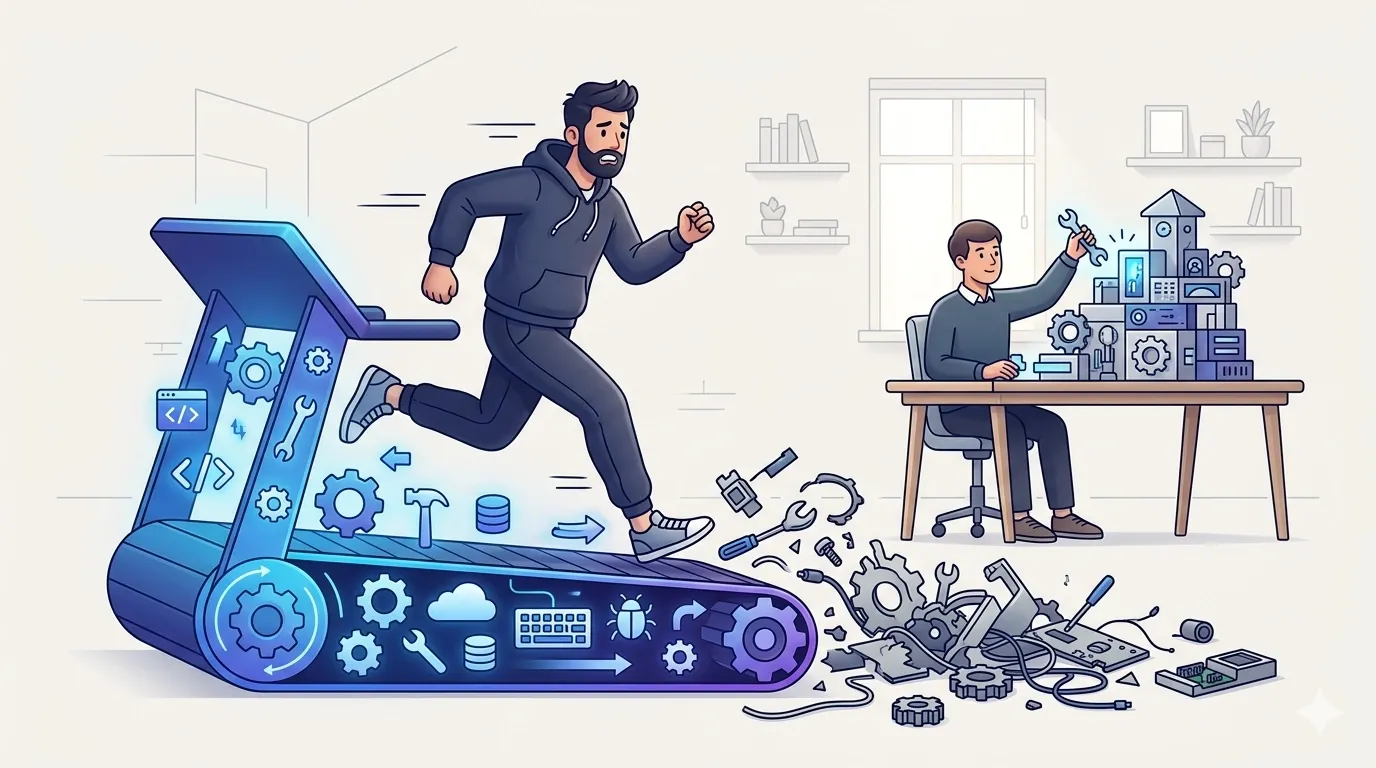
There is a particular kind of engineer — and I have been this engineer — who cannot leave a tech radar alone. A new build tool drops and they are already reading the benchmarks. A better ORM gets traction on Hacker News and they are mentally rewriting the data layer before lunch. A framework releases a major version with a new paradigm and they are drafting the migration proposal before the stable release. This impulse is not stupidity or immaturity. It comes from genuine curiosity and a real desire to build things well. But the habit of always chasing the latest dev tool carries a compounding cost that almost never appears on any roadmap, and most teams don't see it until the damage is done.
I want to make the case that tooling churn is one of the most underestimated sources of slowdown in software teams — not because new tools are bad, but because the full cost of adopting them is almost never honestly calculated before the decision is made.
What the Cost Actually Looks Like
When a team decides to adopt a new tool, the visible costs are easy to list: migration time, documentation updates, maybe some refactoring. These get estimated, debated, and eventually accepted or rejected based on the perceived upside. That calculation is usually fine as far as it goes.
The problem is everything that doesn't go into that calculation.
The first hidden cost is cognitive load on the whole team, not just the person who championed the tool. Every new tool is a new mental model. New configuration conventions, new failure modes, new debugging patterns, new ways things can go wrong at two in the morning. The engineer who spent three weekends learning the new tool deeply is ready for that cognitive load. The four other engineers on the team who got a one-hour onboarding session are not. They carry a persistent low-grade tax on every task that touches the new tool — slower, less confident, more likely to work around it rather than through it.
The second hidden cost is institutional knowledge erosion. When you replace a tool your team has used for three years, you are not just replacing software. You are discarding three years of accumulated understanding — the workarounds, the edge cases, the tribal knowledge of why certain things are configured the way they are. Some of that knowledge lives in documentation. Most of it lives in people's heads. The new tool starts at zero on all of it.
The third hidden cost is decision fatigue on future tooling choices. Every tool adoption opens the door to the next one. Once a team has normalized frequent tooling changes, the threshold for the next change drops. Engineers who pushed back on the last adoption stay quiet this time. Teams that churn tools regularly develop a culture where stability is seen as stagnation rather than a deliberate engineering choice.
The Case for Staying Current (Steel-Manning It)
The argument for chasing new tools is not frivolous, and I want to take it seriously before dismissing it.
Technology genuinely does move. Teams that locked in on their stack in 2015 and refused to revisit it are not in an enviable position today. There are tools that represent genuine step-changes in developer productivity — not marginal improvements but orders-of-magnitude differences in how fast or safely you can build. Missing those inflection points because you were committed to stability has a real cost too.
There is also a talent argument. Developers want to work with modern tooling. Teams running on outdated stacks struggle to attract engineers who have good options elsewhere. Keeping your tooling reasonably current is partly a hiring and retention strategy, and pretending otherwise is naive.
And frankly, some tools really do solve real problems. Not every new framework is hype. Not every new build tool is a solution looking for a problem. Sometimes the new thing is genuinely better in ways that matter for your specific context, and adopting it early means your team builds expertise before it becomes a hiring commodity.
All of that is true. The issue is not whether to adopt new tools. The issue is whether the adoption decision is being made honestly.
The Adoption Decision Is Almost Never Honest
Here is what an honest tooling adoption decision would look like. It would ask:
- What specific problem does this tool solve that our current tool does not?
- How long will it take for the whole team — not just the champion — to be as productive with this tool as they are with the current one?
- What institutional knowledge are we discarding, and how do we capture it before it walks out the door?
- What is the realistic maintenance and upgrade burden of this tool over the next two years?
- Is this tool likely to be better maintained, more stable, and more widely adopted in two years — or are we adopting at peak hype?
- What is the opportunity cost of the engineering time this migration will consume?
In my experience, most tooling adoption decisions answer one of those questions — the first one — and hand-wave the rest. The champion has thought deeply about the problem the tool solves. They have not thought nearly as hard about the full cost of the solution.
This is not malicious. It is a natural consequence of enthusiasm. When you are excited about a tool, you think about its upside. The costs are abstract until they are not.
The Pattern That Actually Works
The teams I have seen navigate tooling well share a few common traits. They are not anti-new-tools. They are deliberate about how new tools enter the stack.
They tend to do something like this:
- Isolate experiments. New tools get tried on greenfield projects, internal tools, or isolated services — not the production critical path. Real-world experience in a low-stakes environment beats any benchmark or blog post.
- Wait for the second wave. The engineers who adopt a tool when it hits 1.0 and has real production users somewhere are in a much better position than the ones who adopted it at the conference talk. Bugs are found, APIs stabilize, community patterns emerge. Waiting six months costs almost nothing and saves significant pain.
- Require a team advocate, not just a champion. The engineer who wants to adopt the tool writes the proposal. A second engineer who did not choose the tool is responsible for poking holes in it. That separation of roles surfaces the costs that enthusiasm obscures.
- Treat stability as a feature. Boring infrastructure that everyone understands deeply is a competitive advantage, not a liability. The team that has used the same database, the same deployment pipeline, and the same observability stack for three years and knows them cold will outship the team that has cycled through four of each.
Where I Land
Chasing the latest dev tool is not a virtue. It is a habit that feels like ambition and often functions as avoidance — the comfortable sensation of making progress without the harder work of shipping on the stack you already have.
New tools deserve genuine evaluation. Some of them are worth the cost of adoption, and the teams that get good at identifying those inflection points early do have an advantage. But the evaluation has to be honest about the full cost, not just the upside that made the tool exciting in the first place.
The most productive engineering teams I have worked with or watched closely have one thing in common: they are boring about their tools and ambitious about their products. They treat their stack as a settled question so they can spend their creative energy on the problems that actually matter to their users. That is not stagnation. That is discipline — and it compounds just as fast as tooling churn does, but in the right direction.