
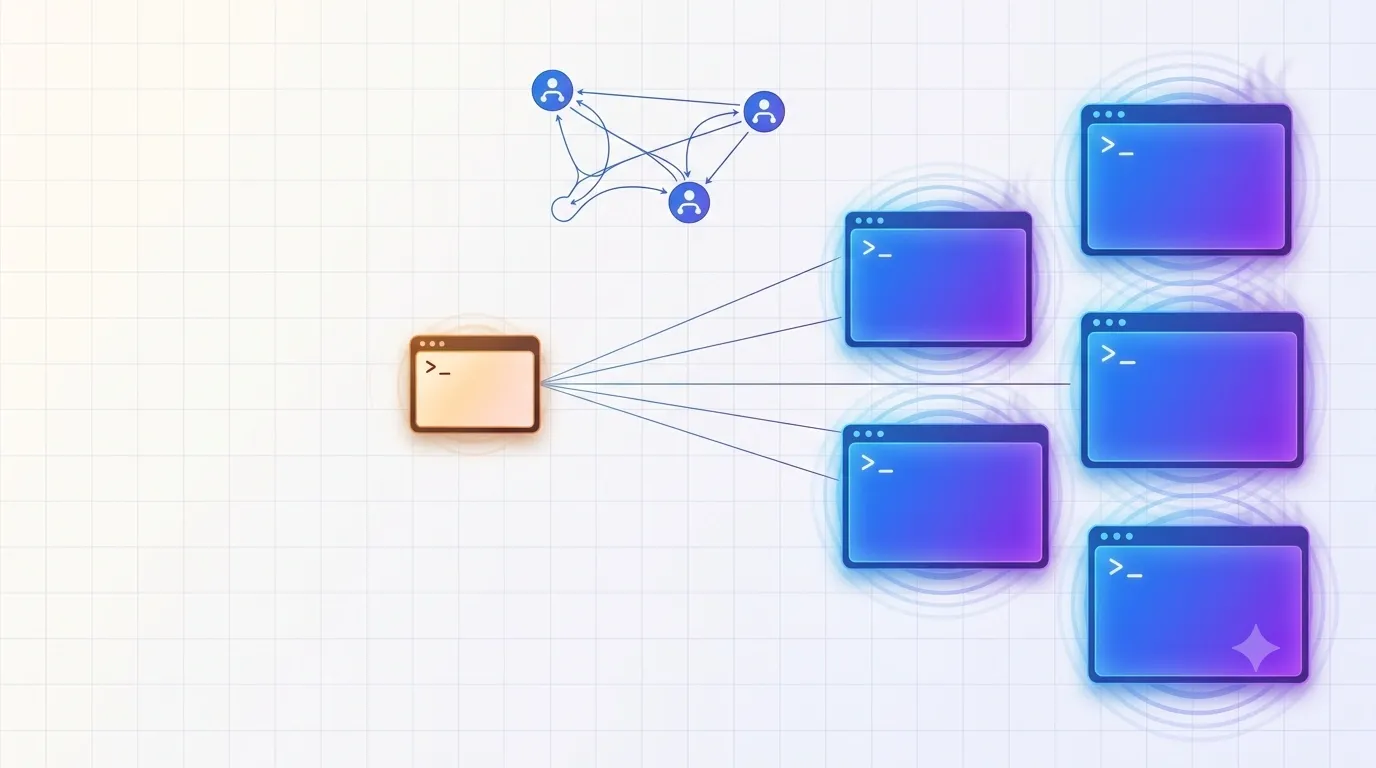
Most AI coding harnesses are electron-adjacent behemoths: they boot slowly, eat memory aggressively per session, and fall apart the moment you try to run more than two or three agents in parallel. jcode is a direct challenge to that status quo. It's a Rust-built AI coding harness that launches in 14 milliseconds, idles at 27.8MB of RAM with local embedding off, adds roughly 10MB per additional session, and ships a genuine multi-agent swarm system — not just "spawn two Claude Code windows and hope for the best." I've been watching this project since it started surfacing in performance-conscious developer circles, and the benchmark numbers, if they hold up to independent replication, are legitimately striking.
The Performance Numbers, In Context
jcode publishes a RAM comparison table on its README and at jcode.sh/bench that pits it against Claude Code, Cursor Agent, OpenCode, GitHub Copilot CLI, Codex CLI, Antigravity CLI, and pi. The methodology uses PSS (Proportional Set Size) — a more honest memory accounting than RSS because it attributes shared pages proportionally rather than fully to each process. The numbers measured on a single Linux machine across 10 launches:
- 1 active session: jcode at 167.1MB (with local embedding), vs Claude Code at 386.6MB, OpenCode at 371.5MB, GitHub Copilot CLI at 333.3MB
- 10 active sessions: jcode at 260.8MB total, vs Claude Code at 2,300.6MB, OpenCode at 3,237.2MB, GitHub Copilot CLI at 1,756.5MB
- Memory per added session: jcode adds ~10.4MB per session; Claude Code adds ~212.7MB; OpenCode adds ~318.4MB
- Time to first frame: jcode at 14.0ms median; Claude Code at 3,436.9ms; Codex CLI at 882.8ms
These are the project's own benchmarks, run on a single machine, with specific tool versions listed. Independent verification matters before treating these as universal truth. But the underlying architecture — Rust binary, custom TUI renderer, shared server process for multi-session — makes the directional claim credible. The marginal cost of session 10 vs session 1 being ~10MB is the number I find most interesting, and it's consistent with a design where sessions share a server process rather than spawning independent node runtimes.
The Swarm System: Multi-Agent That Actually Coordinates
The feature that makes jcode architecturally interesting beyond raw performance is its swarm system. When you spawn two or more agents in the same repository, jcode's server process manages them as a coordinated group rather than isolated sessions. If agent A edits a file that agent B has already read, the server notifies agent B, which can inspect the diff and determine whether it has a conflict. Agents can DM each other, broadcast to all agents in the repo, or message agents by group.
# Launch the TUI (standard interactive session) jcode # Run as persistent background server jcode serve # Attach additional agent sessions to the same server jcode connect # Resume a previous session by memorable name jcode --resume fox
Agents can also spawn their own swarms autonomously. A planning agent can invoke a swarm tool to spawn worker agents for parallel subtasks, automatically managing group membership, messaging channels, and completion status. The main agent becomes a coordinator; the spawned agents become workers. This is headless-capable, which means it can run in CI or remote environments without a terminal attached.
The comparison to current multi-agent patterns in other tools is meaningful here. Running parallel Claude Code sessions in git worktrees is the state of the art for most teams — it works, but coordination is entirely manual. jcode's swarm system attempts to make file-level conflict detection and inter-agent messaging native harness behavior rather than a workflow the developer has to engineer manually.
Semantic Memory: Human-Like Recall Without Tool Calls
jcode's memory system is worth understanding in detail because it's architecturally different from the "store everything in a file and inject it at session start" approach most harnesses use. Every agent turn is embedded as a semantic vector. On each subsequent turn, the conversation embedding is queried against a graph of stored memory entries via cosine similarity. Relevant memories are injected automatically — no tool call required, no manual /remember invocation.
Memory extraction runs on a schedule: semantic drift, every K turns, and at session end. A memory side-agent handles extraction and consolidation, reorganizing memories and checking for staleness and conflicts during what the README calls "ambient mode." There's also an explicit memory tool for cases where the agent wants to actively search or store rather than relying on the passive background process, plus session search for traditional RAG over previous session transcripts.
The practical upshot: if you told jcode three sessions ago how your project handles database migrations, and you're now in a new session asking it to write a migration, the relevant memory can surface automatically without you re-establishing context. Whether this works reliably in practice depends on embedding quality and the ambient consolidation keeping the memory graph clean — both things worth testing with your actual use case before relying on them.
Self-Dev Mode: The Agent Modifies Its Own Source
This is the feature I find most technically audacious. jcode includes a self-dev mode where you tell your agent to enter it, and it begins modifying its own Rust source code — editing, building, testing, then reloading its own binary and continuing work across your active sessions, automatically. The README is honest that this requires a frontier model (GPT-5.5 or equivalent is recommended) and that weaker models can make subtle breaking changes. The infrastructure for this — build scripts, incremental Cargo configuration, reload orchestration — is apparently non-trivial and is presented as an active area of investment.
Whether you'd use this in practice depends on your risk tolerance. But as a proof of concept for a harness that takes "agentic" seriously as an architectural principle rather than a marketing term, it's notable.
Provider Coverage and Session Portability
jcode supports OAuth flows for Claude, OpenAI/ChatGPT, Gemini, GitHub Copilot, Azure OpenAI, and several others. For local models, Ollama and LM Studio are first-class supported. The OpenAI-compatible provider covers OpenRouter, DeepSeek, Groq, Mistral, Perplexity, and a long tail of hosted and self-hosted endpoints. Configuration is via ~/.jcode/config.toml with a jcode provider add CLI command for scriptable setup.
One detail worth flagging: jcode can resume sessions from other harnesses. If a Claude Code or Codex CLI session breaks mid-task, you can resume it from jcode and continue where it left off. Session resume is documented as supported for Codex, Claude Code, OpenCode, and pi. That's a genuinely useful escape hatch for long-running agentic tasks.
Misc Details That Signal Careful Engineering
The README calls out a collection of small optimizations that collectively suggest someone who has thought carefully about real-world usage friction:
- Anthropic cache cold warning — Claude's prompt cache goes cold after 5 minutes. jcode's UI warns you when this happens and flags unexpected cache misses, which can save meaningful tokens on large-context sessions.
- Agent grep with file structure — a custom grep tool that returns function lists and displacement information alongside matches, letting the agent infer file structure without reading the full file. Adaptive truncation based on what the agent has already seen reduces context waste.
- KV cache-aware input interleaving — inputs are sent as soon as they can be without breaking the KV cache. Shift+Enter queues the send until the agent finishes its turn, for cases where you don't want to interrupt mid-response.
- Semantic skill injection — skills are not all loaded on startup. The conversation is embedded and skills are injected only when there's a semantic hit, reducing context overhead for sessions that don't touch specialized workflows.
- Custom mermaid renderer — jcode renders Mermaid diagrams inline in the TUI and side panel using a custom Rust renderer (published separately as mermaid-rs-renderer) that the README claims runs 1,800× faster than the reference implementation, with no browser or TypeScript dependency.
Rough Edges and Limitations
- Very early stage. Version numbers in the benchmark table show
v0.9.1888-dev— this is pre-1.0 software under active development. API surfaces, config formats, and behavior can change between releases. Don't build production workflows on top of it yet without pinning versions carefully. - Self-dev mode requires frontier models. The most interesting architectural feature has a real model quality gate. Budget accordingly if you want to experiment with it.
- Benchmark methodology is self-reported. The numbers are detailed and the methodology is documented, but they were collected on a single Linux machine by the project author. Hardware, OS configuration, and specific tool versions can all affect PSS significantly. Treat the relative ordering as directionally useful rather than universally authoritative.
- Handterm (custom terminal) is a work in progress. The smooth partial-line scrolling improvement requires the custom terminal emulator, which is explicitly flagged as incomplete. Scrolling in standard terminals is described as "well implemented" but the premium experience is pending.
- Windows support is newer than Linux/macOS. The install script handles architecture detection and SHA256 verification, but the Windows notes document warrants a read before deploying in Windows-only environments.
- Documentation is sparse in places. Several features — ambient mode, the browser provider protocol, the swarm architecture — have dedicated docs files but the README links them without inline explanation. Expect to dig into the
docs/folder for implementation details.
If you run multi-session agentic workflows and RAM is a genuine constraint — on a laptop, a small VPS, or a machine running many parallel sessions — jcode is the most credible technical challenge to the current field I've seen. Internal link suggestion: link "session resume from other harnesses" or "Codex CLI session" to a future DevTools post about OpenCode or Codex CLI, which would pair naturally with jcode's cross-harness portability story.