
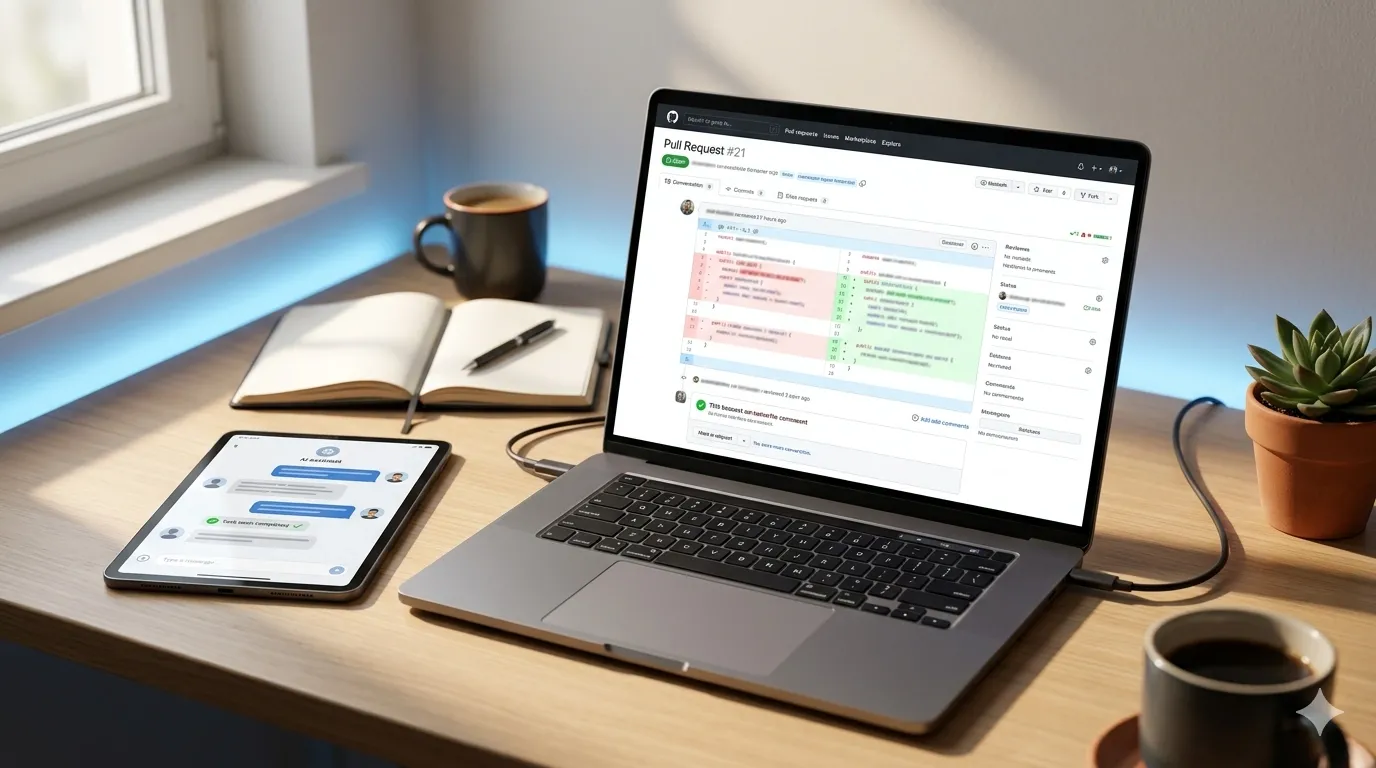
Here's the irony of 2025 development: I spend half my day using AI to write code, and the other half manually reviewing it because I don't fully trust what the AI wrote. PR-Agent closes that loop — it's an open-source AI agent that automatically reviews pull requests, generates descriptions, suggests fixes, and flags issues the moment you open a PR.
I haven't deployed it into production yet (hence the "Bookmarked" tag), but the use case is too obvious to ignore: if Copilot and Claude are writing 40% of my code, I need a second AI to review the first AI's work before it reaches my teammates.
What PR-Agent Actually Does
PR-Agent is a CLI tool and GitHub/GitLab bot (supports Bitbucket and Azure DevOps too) that watches your pull requests and responds to commands. You can trigger it manually or configure it to run automatically on every PR. It handles:
- Auto-description: Reads your diff and writes a structured PR summary — what changed, why, and what files were touched.
- Code review: Flags potential bugs, security issues, performance problems, and style violations. It leaves inline comments just like a human reviewer.
- Improvement suggestions: Proposes refactorings, cleaner patterns, or better variable names — with diff snippets you can apply directly.
- Q&A: You can ask it questions about the PR in a comment, and it answers based on the code context.
- Changelog generation: Extracts user-facing changes and formats them for release notes.
It's model-agnostic — you can plug in OpenAI, Anthropic (Claude), Google (Gemini), Azure OpenAI, or even a local model if you're running your own LLM stack. That flexibility matters if you're in a regulated environment or don't want all your code diffs leaving your infrastructure.
Why This Landed on My Radar
I was reading a post-mortem about an AI-generated function that passed all tests but had a subtle off-by-one error in a loop boundary. A human reviewer caught it in PR review three days later. That's the gap: AI code looks correct, follows patterns, and often works — until it doesn't. Traditional linters won't catch logic errors, and colleagues don't have time to scrutinize every AI-written block.
PR-Agent is purpose-built for this. It's not just a linter; it uses a language model to reason about intent vs. implementation. It can say, "This function claims to validate email addresses, but the regex allows addresses without a domain." That's the kind of review I need when the original code came from a prompt, not from my own reasoning.
Setup (Theory — I Haven't Run It Yet)
The docs show three paths: GitHub Action, GitLab webhook, or local CLI. For GitHub, you install the bot, configure a .pr_agent.toml file in your repo, and set environment variables for your LLM API key. Basic config looks like this:
[config]
model = "gpt-4"
# or "claude-3-5-sonnet-20241022"

[pr_reviewer]
auto_review = true
num_code_suggestions = 4
inline_comments = true
Then you either trigger it with a comment (/review, /describe, /improve) or let it run on every new PR. The bot leaves a summary comment and inline review threads. You can approve its suggestions with a single click, ignore them, or debate them in the thread — it's just another reviewer.
Where I Expect Rough Edges
I'm bookmarking this with a few open questions:
- Cost: Running GPT-4 or Claude on every PR in a busy repo could burn through API credits fast. I'd probably start with a smaller model (GPT-3.5 or a local Llama) and only escalate to GPT-4 for high-risk PRs.
- Noise: AI reviewers can be chatty. If it flags 20 nits per PR, the team will start ignoring it. I'll need to tune the rules and thresholds carefully.
- Context limits: Large PRs (500+ lines) might exceed the model's context window, especially if you're using an older or smaller model. The docs mention chunking strategies, but I haven't tested how well that works.
- Trust calibration: The team will need time to learn which suggestions are gold and which are hallucinated. It's another AI in the loop, not a replacement for human judgment.
Why I'm Prioritizing This Bookmark
Two weeks ago I merged a Copilot-written SQL query that worked in dev but caused a slow scan in production because the AI didn't know our index layout. A second AI reviewer wouldn't have caught the performance issue without schema context — but it would have flagged the missing WHERE clause guard that made the scan worse.
The real value isn't perfection; it's redundancy. If I'm leaning on AI to write code faster, I need another layer of automated scrutiny before human review. PR-Agent slots in between "code generated" and "code shipped." For teams already using AI assistants heavily (see my earlier post on running Continue in VS Code), this feels like the logical next step.
I'm planning to test it on a low-traffic side project first, with manual triggers only, and see whether the suggestions are useful or just noise. If the signal-to-noise ratio is good, I'll propose it to the team as an optional reviewer on our main repos — opt-in per PR, not auto-enabled.
The Meta Loop: AI Reviewing AI
It's a strange loop: AI writes the code, AI reviews the code, and I review the AI's review of the AI's code. But that's where we are in 2025. The alternative is either slowing down (not using AI to write code) or shipping faster with less oversight (risky). PR-Agent is a middle path: keep the velocity, add a safety net, and let humans focus on architecture and logic rather than syntax and style.
I'll report back once I've actually run it. For now, it's bookmarked, starred, and queued up for the next sprint when I have time to configure the GitHub Action and burn some API credits on experiment.